

Article: A Complete Guide to Buying Linen Bedding: What to Look For Before You Buy
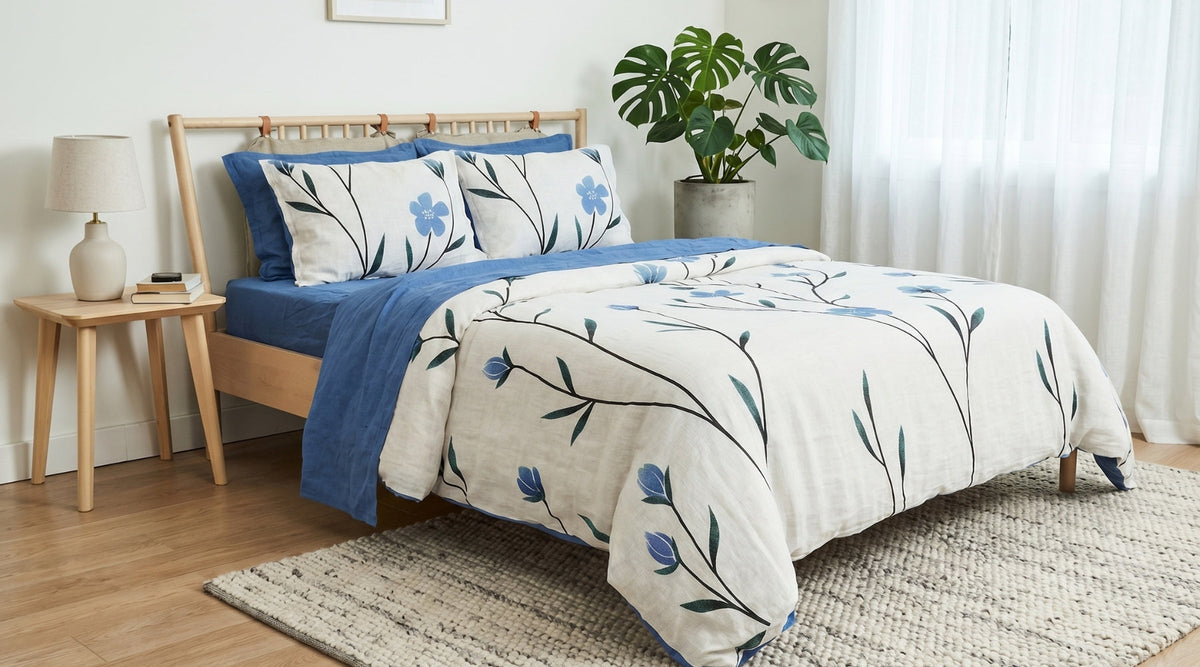
A Complete Guide to Buying Linen Bedding: What to Look For Before You Buy
Discover the details that define exceptional linen bedding, from where the flax is grown and how it is produced to the natural qualities that make linen a beautiful, lasting choice for your home.
Where Is Flax Grown?
In our blog post, Which Country Makes the Best Linen?, we broke down the case for (and against) buying flax linen from different countries, in terms of both quality and social or environmental impact. China came out as the lowest-ranked for both. Although linen-specific information is hard to find due to lack of transparency, its exploitation of cotton workers in Xinjiang is widely documented, and rock-bottom prices likely mean that corners have been cut and harmful chemicals used in the manufacturing process.
We also looked at linen made in Ireland and Italy but found that much of the flax used to make it was grown in France, Belgium, and the Netherlands. With loamy soil and a mild, oceanic climate, these three countries produce the highest-quality flax for soft linen bedding. Flax grown here is long and strong, and doesn’t require harmful chemicals or fertilizers. The fiber is extracted using only rainfall, rather than using water tanks or chemical solvents.
Although some might say that Belgian Linen is the best of all, there’s a catch. While certified Belgian Linen must be woven in Belgium, it can be made from any flax certified Masters of Flax Fibre. In other words: flax grown in France, Belgium, or the Netherlands.

What Certifications Does it Carry?
Many linen bedding companies make all sorts of marketing claims, but there’s no way to verify them. Certifications, where a third party independently assesses the product, help to cut through the noise. The Masters of Flax Fibre certification is one of these. It guarantees that the flax used to make your bedding has been grown only in France, Belgium, or the Netherlands, that it’s traceable from field to fiber, and that it meets strict labor and agricultural standards.
Another certification to look for is the OEKO-TEX Standard 100. It’s an internationally recognized textile safety certification that assesses every part of the product, including fastenings such as buttons, labels, and zippers. In certified OEKO-TEX laboratories, scientists test for more than 1,000 harmful substances, including formaldehyde, heavy metals, Azo dyes, and allergens. They also test for skin-friendly pH levels and make sure that dyes won’t transfer onto the body (a must for dark linens, such as our lovely blue set!). OEKO-TEX certification comes in four classes; Class 1 is the highest, the only one deemed suitable for babies and small children.
The Modern Dane’s Scandinavian-style bedding is certified both Masters of Flax Fibre and OEKO-TEX Standard 100 Class 1. It’s safe for the whole family, including those with sensitive skin, and the sustainable European flax linen is built to stay strong and smooth for many years.

Does Thread Count Matter?
Yes, sometimes, but not in the way you’d think. Linen fibers are much thicker than cotton fibers, so you won’t see the 1,000 thread counts you see on luxury cotton sheets. In fact, as we explained in our 7 Myths About Linen Bedding blog post, these high thread counts can be misleading. It’s not really possible to have thread counts of more than 400 for cotton, so anything beyond that is made from fibers that have been twisted together to inflate the thread count. As testers at Good Housekeeping found out, this can increase pilling and decrease softness.
Linen thread counts typically live in the 80–150 range but higher doesn’t mean better. In fact, more threads can mean thinner, less durable threads. Linen manufacturers, therefore, tend to list fabric weight in GSM (grams per square meter). After testing a variety of linen weights, we settled on 165 GSM as the best balance between comfort and durability.

Does Softness Matter?
Of course! But with linen, softness when new is not always a guarantee of long-term softness. Manufacturers use all kinds of tricks to soften linen, many of which degrade it over time. One tactic is to use softeners that coat the fabric, which may have unintended consequences. One of linen’s best qualities is its breathability, which is due to naturally occurring pores along the length of the flax fiber. Commercial softeners can block these pores, which is why we recommend not using them on your linen at home (use white vinegar instead, which is a natural softener and odor remover).
Some other linens, meanwhile, feel scratchy. This is due to the presence of pectin, a naturally occurring compound in the flax stem. If it is of good quality, such linen typically softens with time, as washing dissolves pectin. We recommend looking at reviews to see how buyers rated their linen over the long term.
There is a third option, however—garment washing. At The Modern Dane, we garment wash our European linen bedding using enzymes, speeding up the dissolution of pectin without compromising linen’s natural qualities. Order a swatch in your favorite color (or design) and feel the softness for yourself.
How is the Bedding Constructed?
If you’re browsing linen in-store (or have just opened it at home), check how it’s been finished, which is often an indicator of overall product quality. Durable, long-lasting linen bedding should have even, dense stitches; common stress points such as corners, buttons, and ties should be reinforced. Our linen duvet covers are woven and finished by artisans in the town of Guimaraes, Portugal, where weaving traditions have endured for generations.

A Different Way of Looking at Price
Quality linen comes at a high cost—that is, if you’re only looking at the price on the label. Instead, we recommend assessing linen by cost per use. High-end, durable linen bedding lasts for years, lowering the cost per use and making the initial outlay much more reasonable. Plus, you’ll sleep better, which will improve your mood, focus, relationships, and overall health—and you can’t put a price on that.
What do you look for when you shop for bedding? How long do you spend comparing products before you make a purchase? Let us know on Instagram, Pinterest, Facebook or Twitter!
En savoir plus
La différence entre une couette et une couette
« Couette » : ce n'est pas seulement un mot sophistiqué pour désigner une couette ! Plongez dans son origine, découvrez sa signification et découvrez pourquoi cette tendance européenne en matière d...
En savoir plus

Laisser un commentaire
Ce site est protégé par hCaptcha, et la Politique de confidentialité et les Conditions de service de hCaptcha s’appliquent.